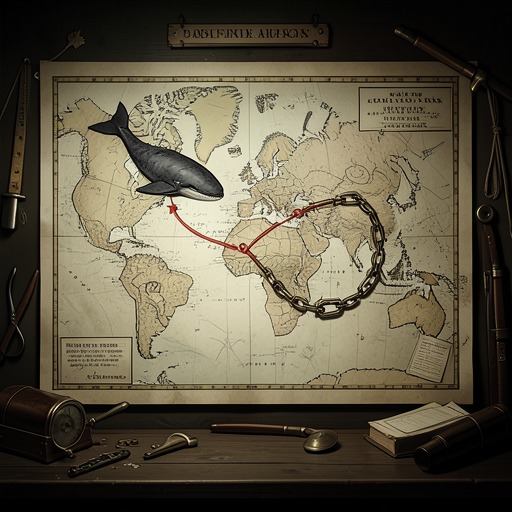
The parallel between whaling and slavery
The WhaleThe parallel between whaling and slavery in this account is not an assertion that human enslavement and the killing of whales are equivalent. It is a way of seeing how two lucrative, ocean-spanning industries organized people and animals as resources, and how their systems of labor, ownership, and classification shaped the world of Herman Melville’s Moby Dick. New Bedford’s whaling wealth and its abolitionist history make that entanglement visible, while the changing legal treatment of whales shows how a once-profitable prize could become a public burden.
Industries and the maritime world
In the eighteenth and nineteenth centuries, whaling and slavery coexisted as profitable, exploitative transoceanic industries. Their ships could even borrow one another’s disguises: whalers sometimes made their vessels resemble men-of-war to deter pirates, while slave ships evading Unionist blockades during the American Civil War could pose as whalers. The resemblance was practical as well as symbolic. One trade carried dead whales for processing; the other transported enslaved people. A half-scale whaling ship displayed in a vaulted hall at the New Bedford Whaling Museum makes the comparison spatial: its cramped lower decks recall the confined interiors of slave ships, although the cargoes and the harms were fundamentally different.
New Bedford’s prosperity depended on a workforce drawn from far beyond the town. The account describes American whaling crews as including Africans, Indigenous people, Azoreans, and Cape Verdeans, as well as people born elsewhere who made up a large share of the men at sea. In the 1840s, three hundred whale ships sailed from the port, more than half the American fleet. Whaling offered employment and mobility to some men of color, but it did not erase racial hierarchy: shipboard bunks remained segregated, and working conditions became so poor that, by the end of the century, men of color were among the few still willing to sign on. The industry could offer a livelihood while continuing to impose unequal conditions.
Frederick Douglass and New Bedford
Frederick Douglass arrived in New Bedford in 1838 after escaping slavery from Baltimore in sailor’s dress. For four years he worked at a range of manual jobs, including rolling casks, stowing ships, sawing wood, sweeping chimneys, and working a blacksmith’s bellows. The account places this labor beside Ishmael’s description of a whale ship as an education: for Douglass and other Black workers, the shipyard could serve as a schoolhouse. It was also a workplace within a port shaped by whaling’s demand for labor.
The town’s population makes that intersection concrete. By the second quarter of the nineteenth century, one in twenty New Bedford residents was Black, a higher proportion than in New York, Boston, or Philadelphia. Neighborhood names such as Little Faial and New Guinea reflected the presence of immigrant communities, and a dozen languages could be heard on its streets. Black sailors were hired by some shipowners who asked few questions, and by some Quaker owners whose religious opposition to slavery mattered in a slaveholding nation. A few rose to captain or mate; Lewis Temple, a Black inventor in New Bedford, developed the hinged toggle-iron harpoon. Such openings existed within a larger system that continued to segregate and exploit workers.
New Bedford was also a stop on the Underground Railroad. Its port traffic and the transient character of maritime work could help fugitives find employment and move onward. Douglass’s experience therefore complicates any simple division between a free northern port and the exploitative industries that sustained it: the same city could offer a near approach to freedom while remaining bound to whaling’s labor economy. A portrait of Douglass placed near the ship replica in the museum brings these histories into the same physical frame without making them interchangeable.
Classification, color, and literary analogy
The political crisis of 1850 gives the comparison its particular force in Moby Dick. As Herman Melville began writing, the Fugitive Slave Law extended slaveholders’ power to pursue people across state boundaries, and conflict between North and South was intensifying. Melville turned that crisis into a cetological analogy. Ishmael observes that the English Greenland whale and the American right whale share their grand features, while purported distinctions rest on inconclusive differences. In this passage, the elaborate division of whale kinds exposes the instability of classifications that claim to establish radical difference.
The analogy resonates with the racial politics surrounding the novel, but it does not reduce those politics to zoology. Elsewhere, Ishmael describes a whale of Ethiopian hue hunted to death, while the whiteness of Moby Dick reflects on America’s preoccupation with color. The whale becomes a means of examining how color and categories acquire meaning, and how distinctions can be used to organize perceptions of belonging and difference. The novel’s cetological language gives the historical crisis a formal echo: classification itself becomes part of the problem.
Ownership and the changing value of whales
The comparison also extends through property. At the 1825 Tunstall stranding, the whale’s status depended on jurisdiction: in Holderness, it became the property of the Lord Paramount of the Seigniory, the Squire of Burton Constable Hall, whereas elsewhere on the English coast such a whale would have been claimed by the Crown as a royal fish. The account sets this legal claim beside the whale’s body as a record of human violence, marked by embedded weapons. A stranded whale could thus be treated simultaneously as an injured animal and as an asset whose ownership was determined by place and privilege.
That older prerogative persisted in altered form. Since 1324, whales, dolphins, porpoises, and sturgeons found on English shores had belonged to the monarch. In the twenty-first century, the Receiver of Wreck instead faced the practical responsibility of managing dead or dying animals: a whale at sea could threaten shipping, while one ashore could require cordons and heavy machinery. Disposal could cost thousands of pounds, with large whales costing as much as £20,000 to move. The change is striking: what once represented a valuable bounty had become a public expense. It parallels the account’s broader argument that resource systems can outlast the conditions that made them profitable.
Regulation and the limits of reform
The history of whaling regulation adds an international dimension to the account’s critique. A 1935 agreement drafted under the League of Nations and ratified by Britain and Norway proved insufficient. In May 1936, the two countries met in Oslo to widen its scope; the resulting restrictions included a December-to-March season and limits on whale catchers operating with factory ships. In 1937, a larger conference in London announced a convention restricting pelagic whaling and protecting certain whales, calves, and females accompanied by calves. These measures arose partly from concern over declining whale populations, but the account emphasizes that restraint also served the interests of established whaling nations.
In 1982, the International Whaling Commission instituted a worldwide moratorium, which took effect in 1987. The measure came after immense population losses and did not remove the whale from human systems of harm. Noise and chemical pollution, fishing-gear bycatch, plastic, and warming oceans continued to threaten cetaceans across national boundaries. The parallel with slavery remains historically specific, but both histories expose the limits of reform when economic interests and systems of control persist. In the account’s final movement, the whale is no longer simply a prize to be claimed: it becomes an early warning of ecological damage, while the older language of ownership gives way—imperfectly—to responsibility.